Campaigns Portal
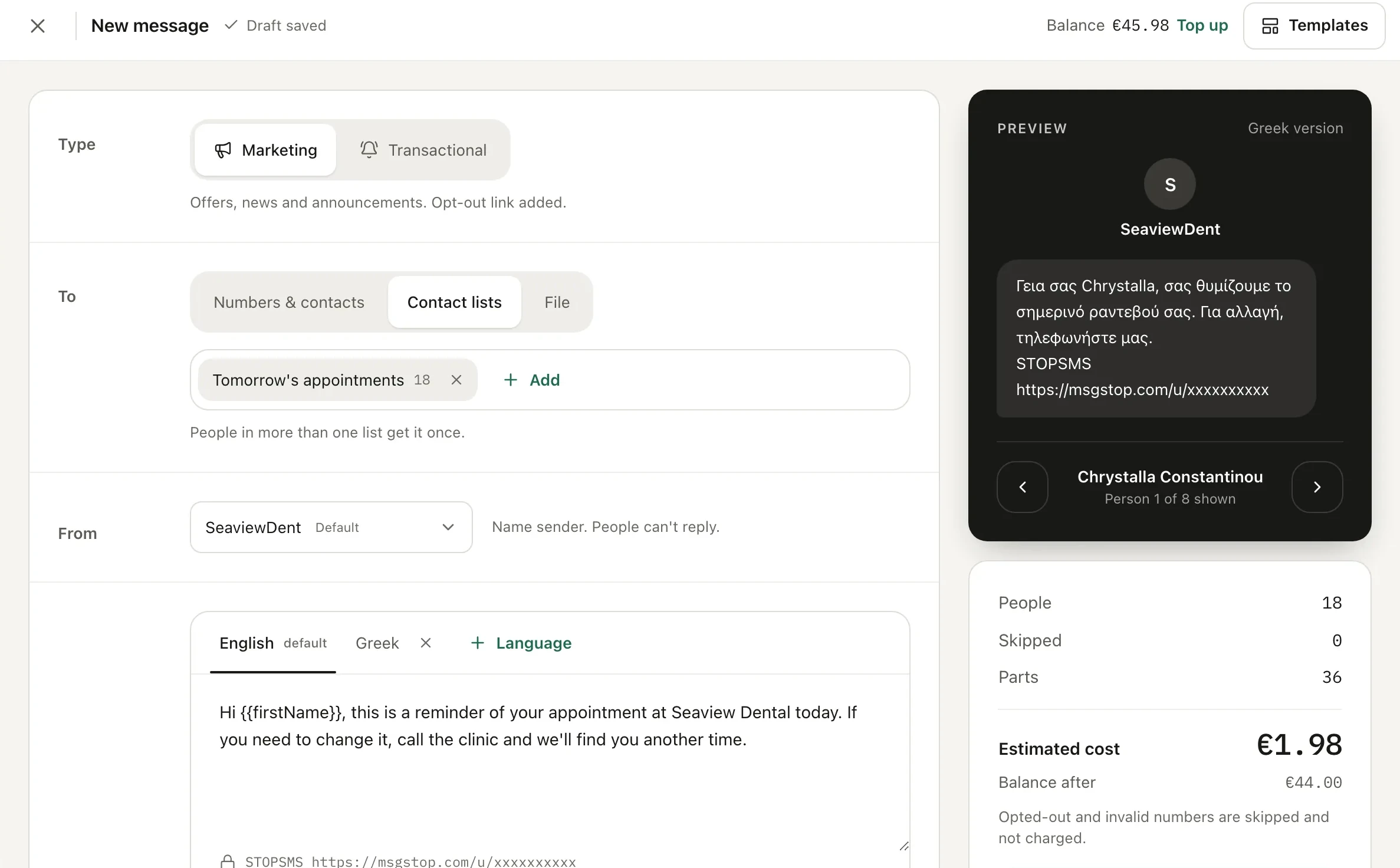
A Next.js portal for contacts, smart lists and campaigns. Customers see the exact cost before they send, schedule or repeat campaigns, and track every delivery. Billing, invoices and a full transaction ledger sit alongside.
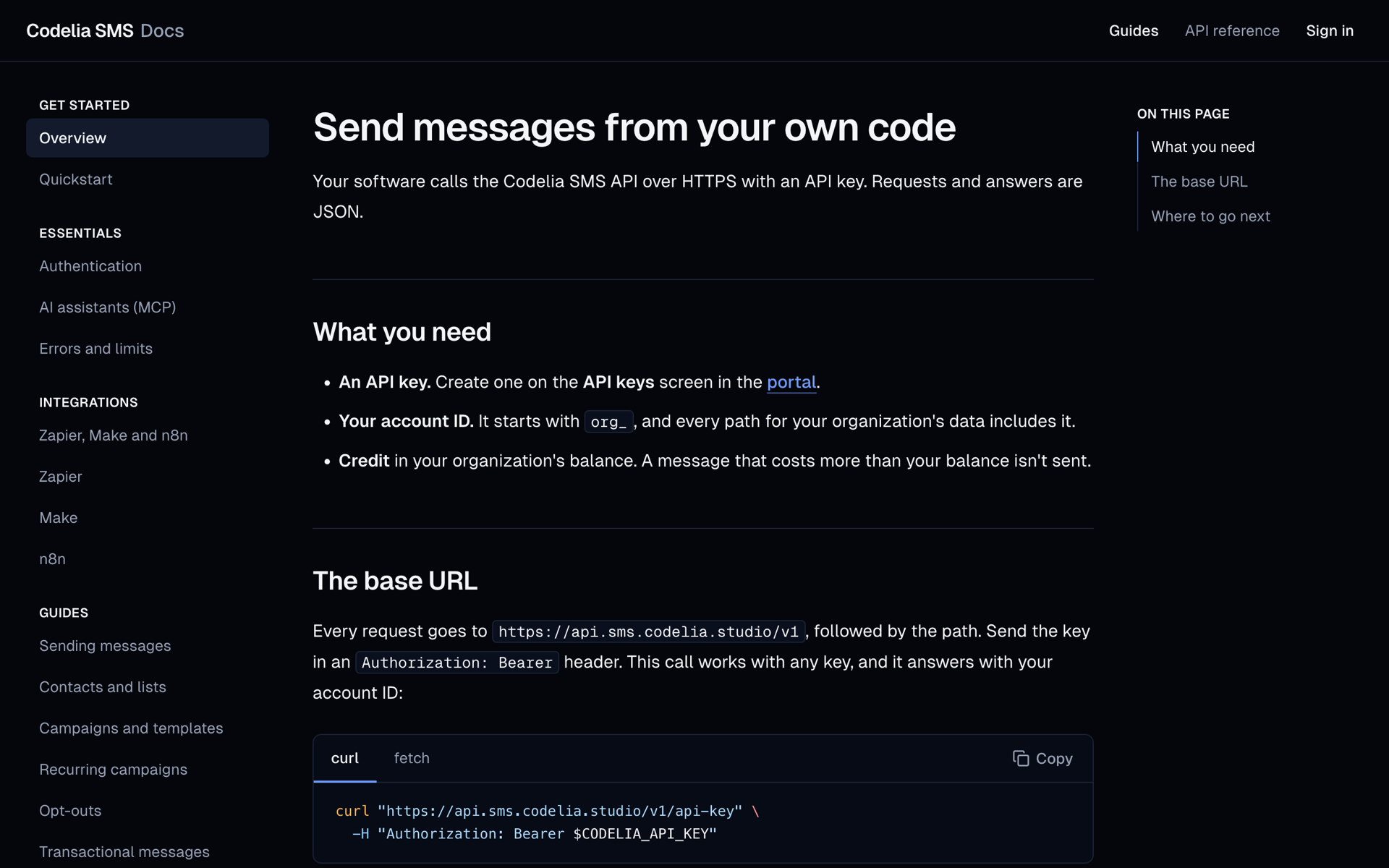
Codelia SMS is a business messaging platform we designed, built and operate ourselves. Businesses send campaigns from a web portal, a public API or their AI assistant. Billing, EU invoicing and fraud protection are built in.
Most SaaS products run into the same hard problems. They take customers' money. They offer an API that other teams build on. Many organisations share one system. And now, AI agents act on customers' behalf.
We built Codelia SMS to solve all four in one product, in production, under our own name. Businesses use it to send appointment reminders, offers and alerts by text message.
Every message has a cost, so every bug is a billing bug. That set the bar for the whole platform.
Real customers. Real money. A platform we answer for ourselves.
of the hardest SaaS problems, solved in one platform
Codelia SMS handles all four in production.
Customers use the web portal, call the API from their own software, or ask an AI assistant. All three run through the same pricing, permissions and balance, so they always agree.


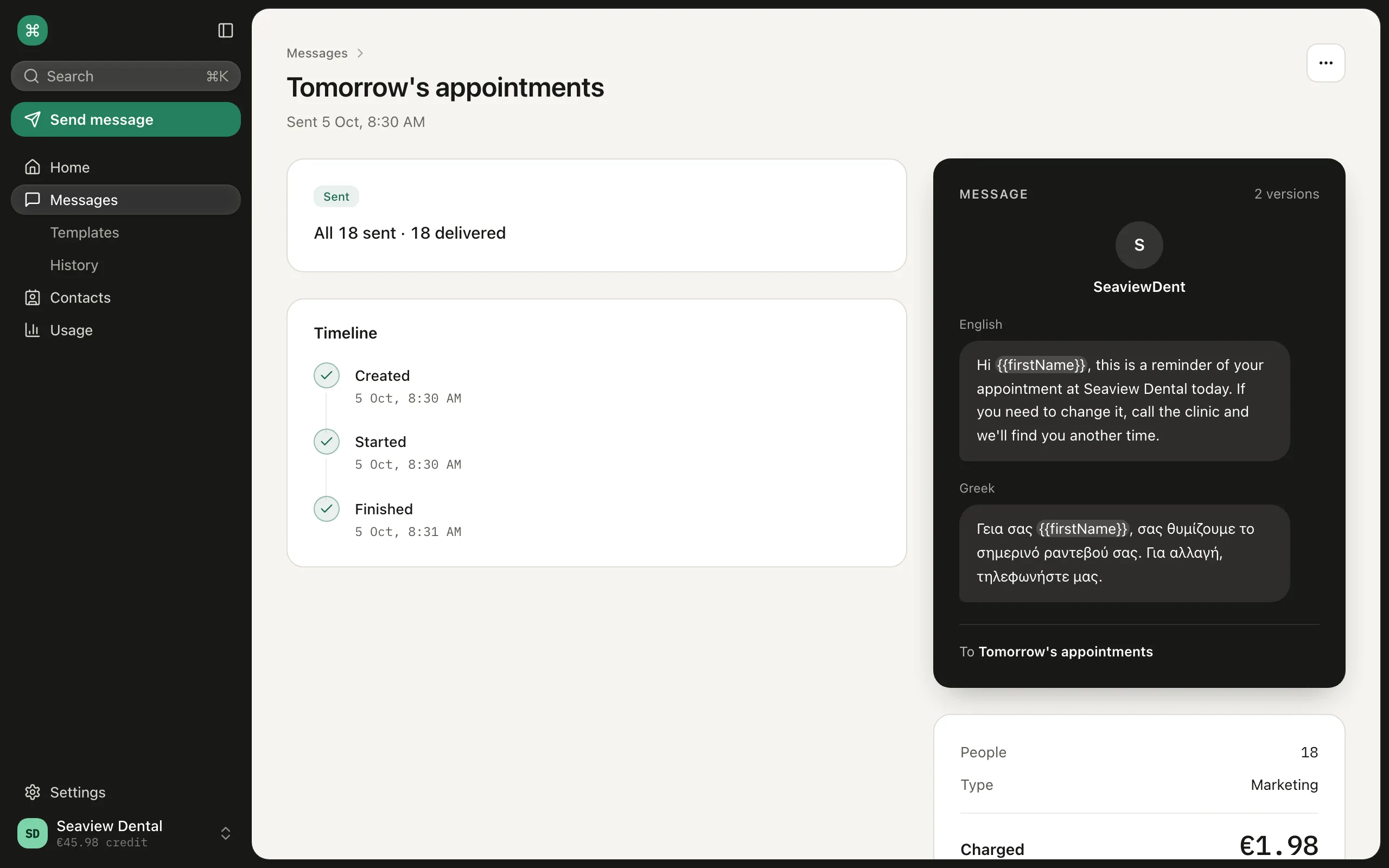
A Next.js portal for contacts, smart lists and campaigns. Customers see the exact cost before they send, schedule or repeat campaigns, and track every delivery. Billing, invoices and a full transaction ledger sit alongside.

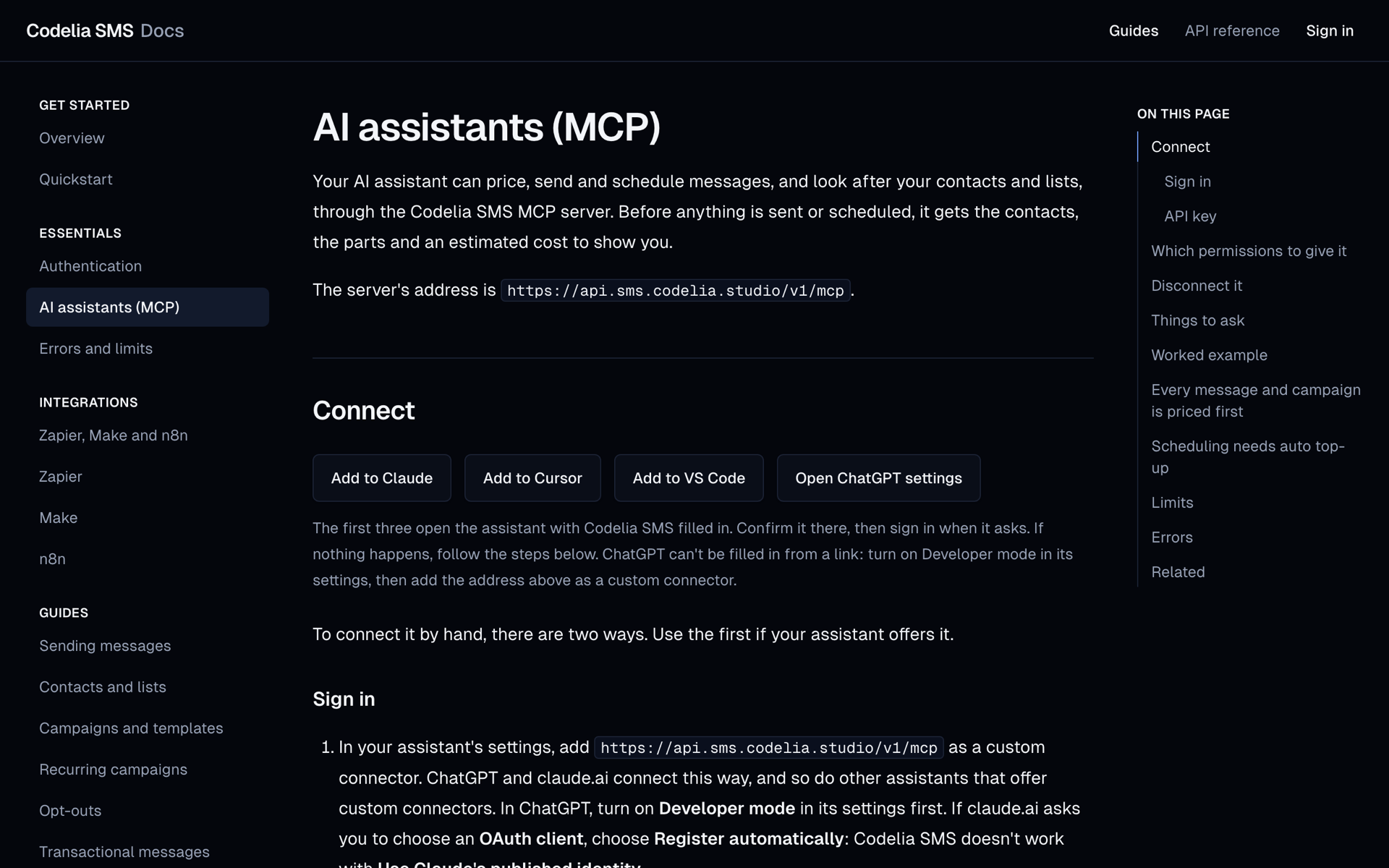
A public REST API with an OpenAPI spec, a docs site and signed webhooks. An MCP server gives Claude, ChatGPT and other assistants 22 tools to manage contacts and send campaigns, limited to what the customer allows. Zapier, Make and n8n connect without code.
Behind the screens: the services that move messages and money.
One Hono API on AWS Lambda serves the portal, customers' code and AI assistants. Internal routes never appear in the public spec.
Large campaigns run from an SQS queue. Each worker hands off before its time limit, so a send of any size finishes.
EventBridge runs scheduled sends, payment reconciliation and monthly summaries. Every job is safe to run twice.
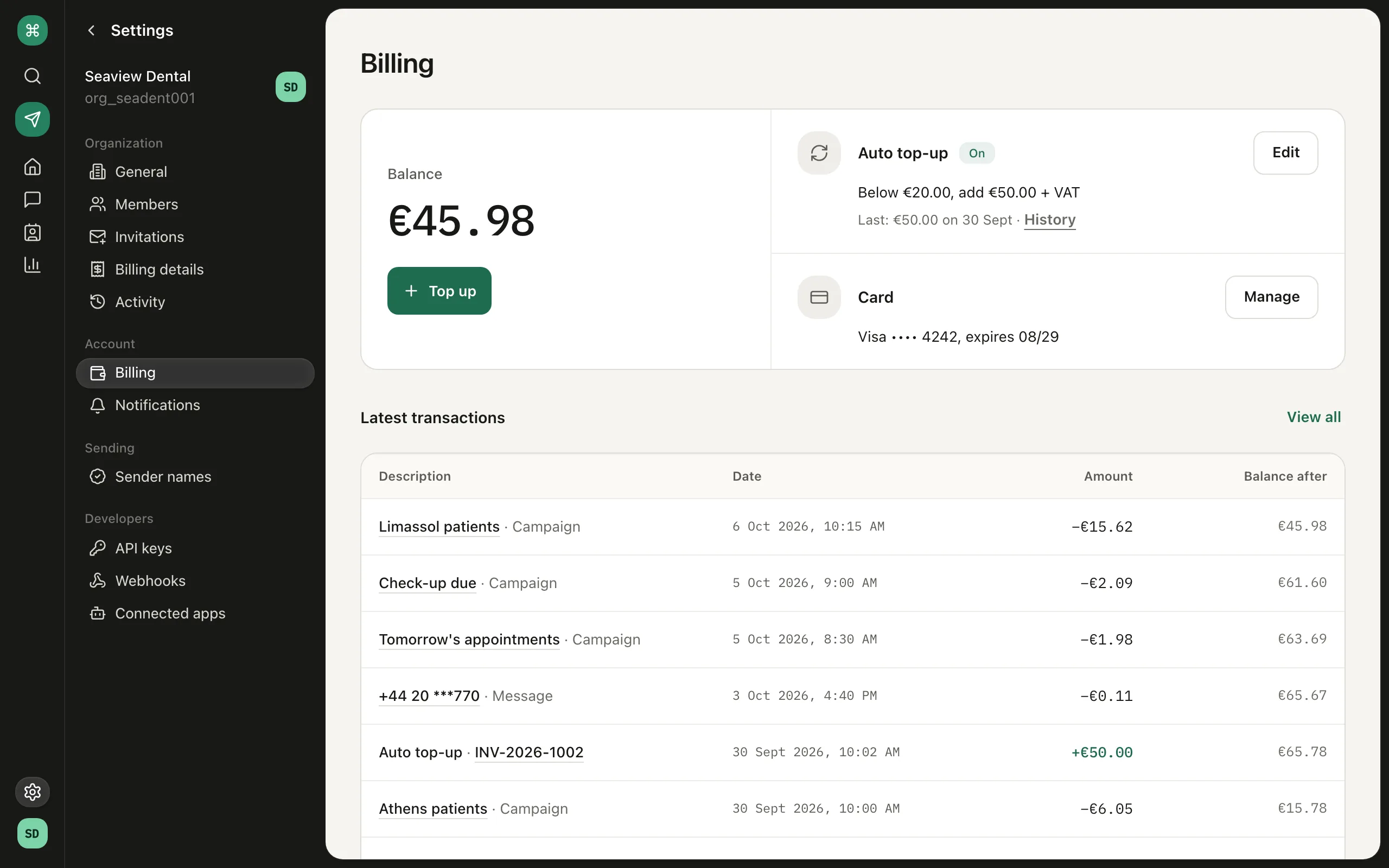
Stripe payments, prepaid credit and automatic top-up. Every payment gets a PDF invoice with the right VAT treatment.
Every event is signed and versioned. Failed deliveries retry automatically, and customers can replay any recent one.
Our team approves sender names, manages rates and adjusts credit. Every staff action is audited.
A Turborepo monorepo, deployed with SST to AWS in the EU. One CloudFront router serves every app. One Hono API serves every client. Postgres is the single source of truth for every message, contact and euro.
SMS rates are fractions of a cent, and floating-point maths drifts. So every amount is stored as a whole number of micros: millionths of a euro. A €0.0075 rate is exactly 7,500.
Prices are rounded once, when they're quoted, and the quote is final. Customers pay exactly what they saw before sending.
If a customer's code times out and retries, a naive API charges twice and sends twice.
Every endpoint that changes data accepts an idempotency key, following the same rules as Stripe. The database enforces it, so it holds across every server. It shipped with the first version of the API, so no integration ever had to change to get it.
Serverless functions have time limits. Large campaigns go onto a queue, and each worker hands off to the next one before its time runs out.
The timeouts are staggered so no batch is processed twice. Opt-outs are checked again at every hand-off, so someone who unsubscribes mid-campaign is never texted or charged.
Customers connect Claude, ChatGPT or another assistant over MCP and choose exactly what it's allowed to do.
An assistant can't send anything on its first call. It gets a quote with the recipients and the cost, shows it to the person, and sends only once they confirm.
SMS pumping is the most common fraud against SMS platforms. Attackers push traffic to premium numbers they control, and the platform pays the bill.
Our guard combines trust tiers, rate limits and destination risk scoring. Staff can let trusted customers through, and every exception is audited. If the guard itself fails, sending carries on.
Costs shown before sending. The editor flags any character that would double a message's price and offers a fix.
Private by default. Asking for an organisation you don't belong to returns "not found", so the API never confirms it exists.
Scheduled sends priced on the day. No money is held in advance, and opt-outs are checked again before sending.
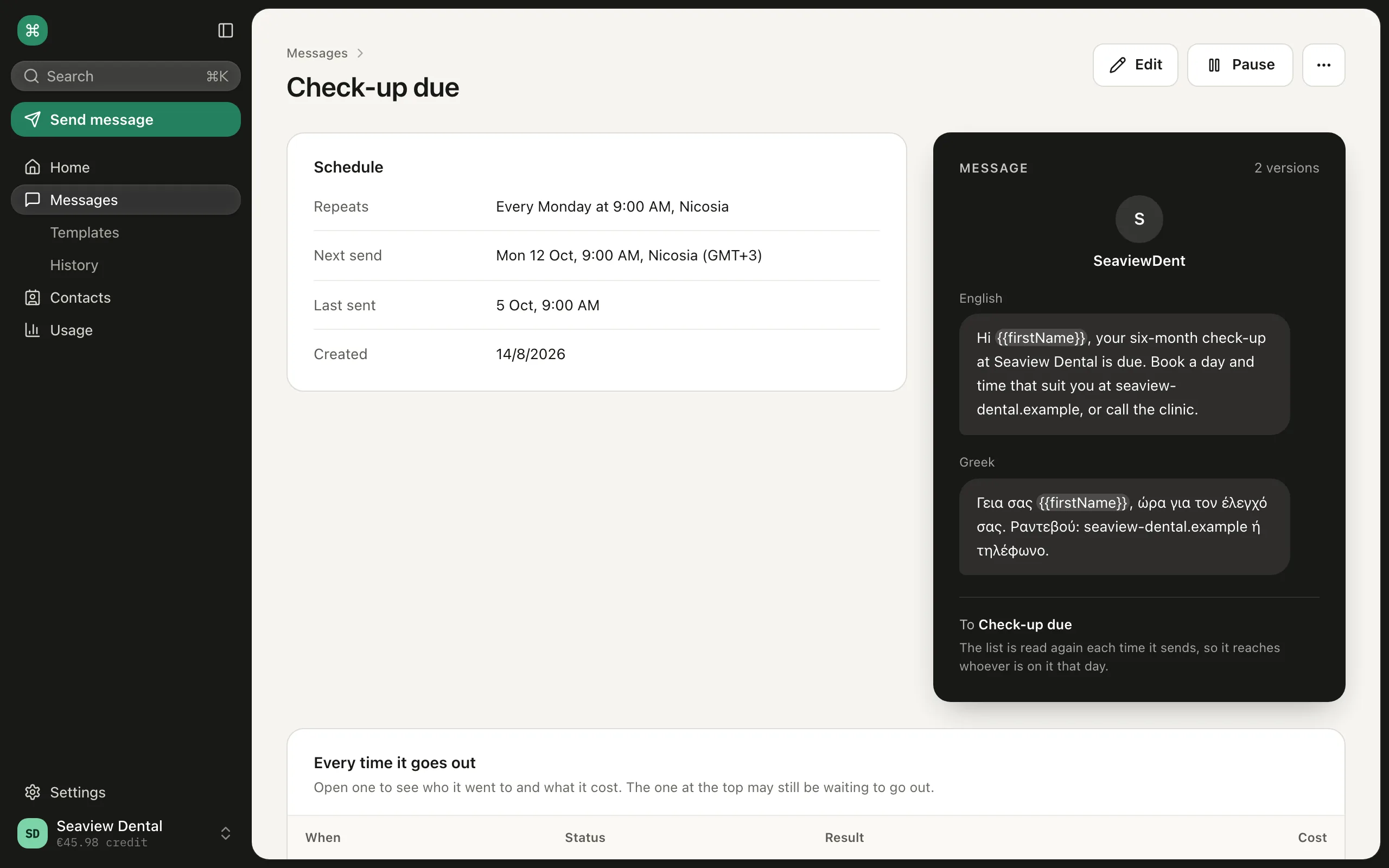
Self-healing recurring campaigns. They refresh their lists on every run and pause themselves after three failures.
Fine-grained permissions. An accountant can see billing and invoices without being able to send anything.
EU invoicing built in. VAT or reverse charge on every invoice, and automatic credit notes for refunds.
Webhooks developers can trust. Signed, versioned, and safe to deduplicate across retries.
A customer-facing activity log. Teams can see who changed what, from revoked API keys to edited lists.
Hosted in the EU. With point-in-time recovery and backups copied to a second EU region.
Codelia SMS isn't a demo. It takes real payments, sends real messages and serves real customers, and we operate it ourselves.
That's the standard we bring to client work: billing that reconciles to the cent, APIs other teams can build on, AI features with guardrails, and infrastructure that stays cheap to run.
If you're planning a SaaS platform, a customer portal, a public API or an AI integration, we'd love to hear about it.